



FDM 3D printing
Read more

Variety of materials

Large parts

Cost-effective
Manufacturing process
Methodology
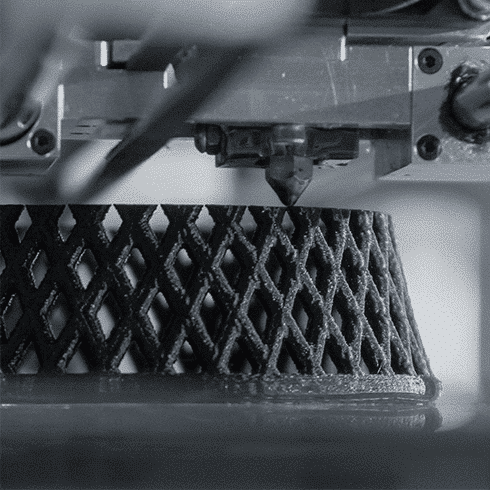
FDM (Filament deposition manufacturing) involves melting a thermoplastic wire through a nozzle heated to high temperature. The molten filament (of the order of a tenth of a millimeter) emerging from the nozzle is laid down in line, and bonds to what has already been laid down. The part is built by depositing a molten filament extruded by a heated nozzle guided by CAD data.
Our strengths
- Professionals who listen
- Technical expertise
- Proposal-driven
- ISO 9001 – EN 9100 certification
Applications
- Test your prototypes
- Manufacture durable, high-stability parts
- Production of educational tools
- Jig production
Our equipment
- 1 STRATASYS Fortus® 900MC – capacity: 914 x 610 x 914mm
- 1 STRATASYS Fortus® 450MC – capacity: 406 x 355 x 406mm
Our materials
- NYLON 12CF
- ABS M30
- ABS ESD7
- POLYCARBONATE
- ULTEM® 9085
- ULTEM® 1010
-
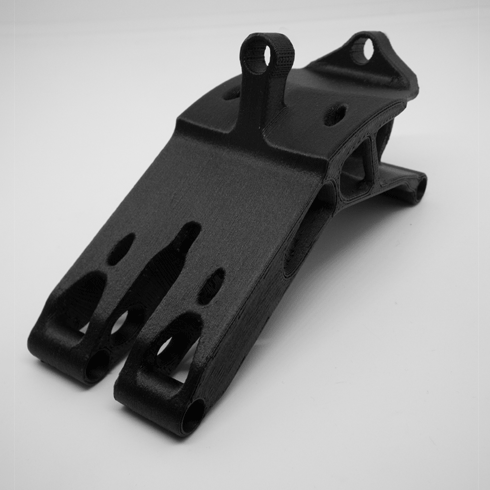
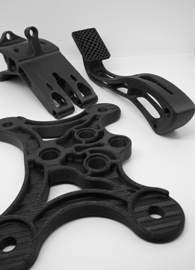
NYLON 12CF
FDM Nylon 12 Carbon Fiber (Nylon 12CF) combines Nylon 12 with carbon fibers to achieve a flexural strength and strength-to-weight ratio superior to any FDM material. Validate designs faster with functional carbon fiber prototypes. Replace heavy metal tools with lighter, more ergonomic Nylon 12CF tools.
Download the data sheetProperties- Black
- Polyamide 12 reinforced with “short” carbon fibre, making up 35% of its weight.
Advantages- Flexural strength
- Thermoplastic suited to tooling production
Limitations- Surface finishes
Accuracy- Layer: 254 μ
- Recommended wall thickness: 1.5 mm
-
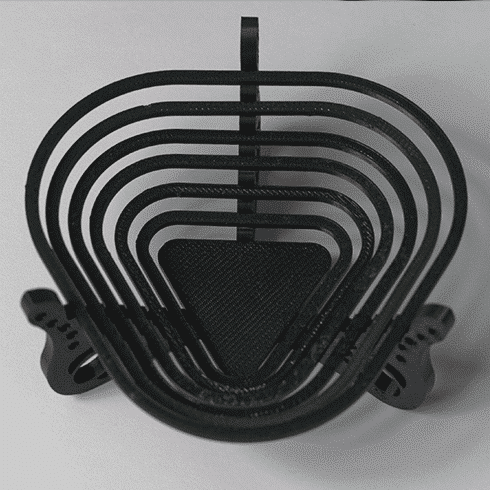
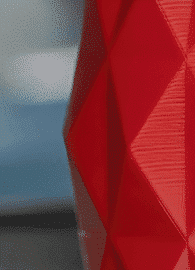
ABS M30
ABS M30 is an engineering thermoplastic known for its strength, robustness, lightness and resistance. This material is ideal for form and fit checks, as well as for prototyping functional parts.
Download the data sheetProperties- Ivory
- Black
- Red
- Other shades on request.
Advantages- Certifications : UL 94 / -HB
- Good dimensional stability
Limitations- Surface finishes
Accuracy- Layer = 0.178 to 0.33 mm
- Recommended wall thickness = 1.2 mm
-
ABS ESD7
ABS ESD7 is an engineering thermoplastic known for its strength, toughness, lightness and resistance. This material is ideal for form and fit checks, as well as for prototyping functional parts.
Download the data sheetProperties- Black
- Antistatic
Advantages- Certifications : UL 94 / -HB
- Good dimensional stability
Limitations- Surface finishes
Accuracy- Layer = 0.178 to 0.33 mm
- Recommended wall thickness = 1.2 mm
-
POLYCARBONATE
Polycarbonate (PC) is a material offering precision, durability and stability. It can be used to produce solid parts capable of undergoing functional testing.
Download the data sheetProperties- White
Advantages- Certifications : UL 94 / -HB
- Sturdiness
Limitations- Surface finishes
Accuracy- Layer = 0.178 to 0.33 mm
- Recommended wall thickness = 1.2 mm
-
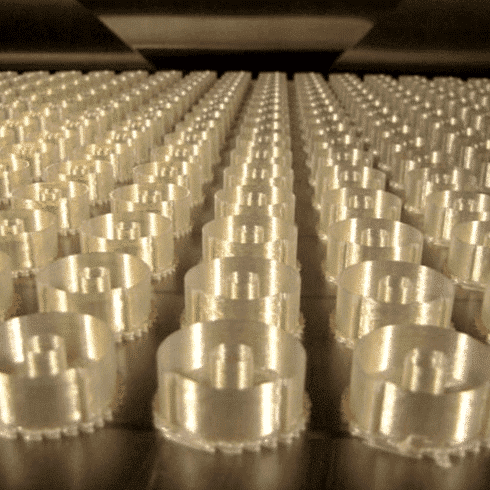
ULTEM® 9085
ULTEM™ thermoplastic is a high-performance, flame-retardant material characterized by a high strength-to-weight ratio and excellent impact resistance.
Download the data sheetProperties- Gold
- Black
Advantages- Certifications UL 94 / V-0
- Railway standard EN-45545-2
- Heat resistance
Limitations- Surface finishes
Accuracy- Layer = 0.178 to 0.33 mm
- Recommended wall thickness = 1.2 mm
-
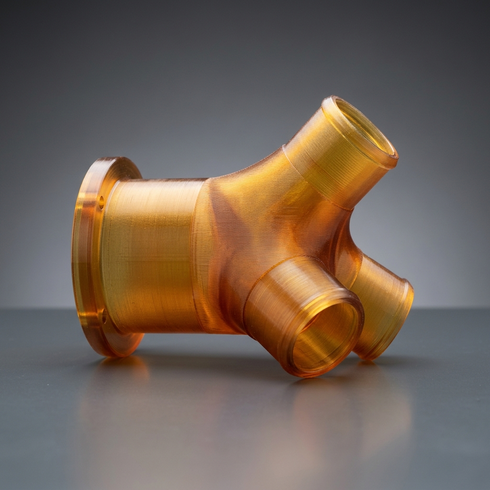
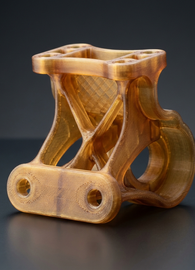
ULTEM® 1010
ULTEM™ 1010 thermoplastic offers the highest tensile strength, chemical resistance and heat resistance of all FDM materials. Its exceptional thermal stability and its CG certified grade make it the ideal choice for medical and food-contact applications, and for high-performance tooling.
Download the data sheetProperties- Amber natural
- Excellent dimensional stability
- Two grades: standard and CG (Certified Grade)
Advantages- Biocompatibility certifications ISO 10993 / USP Class VI (CG grade)
- Food contact approval NSF 51 (CG grade)
- Extreme heat resistance (214°C to 217°C)
- Flame retardancy (V0 Blue Card certification #E345258)
Limitations- Surface finishes
Accuracy- Layer = 0.178 to 0.33 mm
- Recommended wall thickness = 1.2 mm
Comparison of 3D technologies and plastics
Do you know which material is the most suitable for your FDM 3D printing project?
View our comparison or why not get in touch with us.